

Trucking Business Plan Templates: What Does a Lender Need to Fund a Trucking Company?
For most trucking owners, the truck is the biggest check they ever write, and most finance it. The lender is not betting on the truck. The lender is betting on you running it at a profit.
Show them the miles, the rate, the cost, and the payment. These templates are built around exactly that math, for every kind of trucking and transport business.
Not sure which one fits your rig? Call or text (321) 948-9588.
Last Updated: 11/07/2026 · Written by Dr. Paul Borosky, DBA, MBA
Before You Sign for the Truck
A trucking lender is checking one thing: can this operation cover the note in a slow month? Your plan has to answer that with numbers, not hope.
- A rate that covers the mile, the note, and you. Fuel, insurance, maintenance, and tires per mile, plus the truck note and your own pay, spread over the miles you actually run.
- A realistic load picture. Where freight comes from, and how many of your miles run empty.
- Money in the deal. Your down payment, your equity, and what the loan buys.
Credit and collateral still matter. The plan is how you prove the rest.
Pick the Template That Matches How You Haul
Trucking is not one business. A broker never buys a truck. A hot shot driver never pulls a 53-foot trailer. Start with the one that matches how you get paid.
Trucking Company
Semis and trailers, truckload or LTL. $100. Advanced Edition for bigger loans.
Box Truck
Straight trucks on local and regional runs. $50. Advanced Edition available.
Hot Shot Trucking
Pickup and flatbed, time-sensitive loads. $50.
Freight Broker and Dispatcher
You move the loads, not the trucks. Revenue from customers served. $50.
Courier and Last Mile
Courier starts from deliveries. Last Mile starts from miles. $50 each.
NEMT and Ride-Sharing
Moving people, not freight. Revenue from riders. NEMT and Ride-Sharing, $50 each.
Towing, Moving, and Dump Truck
Towing and Moving start from customer jobs. Dump Truck starts from miles. $50 each.
Looking for another industry? See all business plan templates by industry.
Showing all 13 results
-
Industry Business Plan Templates
Box Truck Business Plan Template
Original price was: $100.00.$50.00Current price is: $50.00. Add to cart -
Industry Business Plan Templates
Box Truck Company Business Plan Template, Advanced Edition
Original price was: $199.00.$100.00Current price is: $100.00. Add to cart -
Industry Business Plan Templates
Courier Service Business Plan Template
Original price was: $100.00.$50.00Current price is: $50.00. Add to cart -
Industry Business Plan Templates
Dump Truck Business Plan Template
Original price was: $100.00.$50.00Current price is: $50.00. Add to cart -
Industry Business Plan Templates
Freight Broker and Dispatcher Business Plan Template
Original price was: $100.00.$50.00Current price is: $50.00. Add to cart -
Industry Business Plan Templates
Hot Shot Trucking Business Plan Template
Original price was: $100.00.$50.00Current price is: $50.00. Add to cart -
Industry Business Plan Templates
Last Mile Delivery Business Plan Template
Original price was: $100.00.$50.00Current price is: $50.00. Add to cart -
Industry Business Plan Templates
Moving Company Business Plan Template
Original price was: $100.00.$50.00Current price is: $50.00. Add to cart -
Industry Business Plan Templates
Non-Emergency Medical Transport Business Plan Template
Original price was: $100.00.$50.00Current price is: $50.00. Add to cart -
Industry Business Plan Templates
Ride-Sharing Business Plan Template
Original price was: $100.00.$50.00Current price is: $50.00. Add to cart -
Industry Business Plan Templates
Towing Company Business Plan Template
Original price was: $100.00.$50.00Current price is: $50.00. Add to cart -
Industry Business Plan Templates
Trucking Company Business Plan Template
Original price was: $150.00.$100.00Current price is: $100.00. Add to cart -
Industry Business Plan Templates
Trucking Company Business Plan Template, Advanced Edition
Original price was: $199.00.$100.00Current price is: $100.00. Add to cart
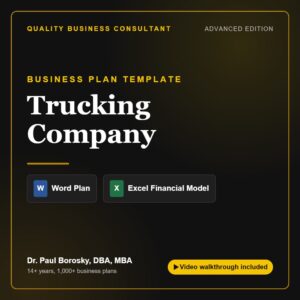
Inside the Trucking Models
No formulas to write. You enter what you already know about your trucks.
- Miles drive the revenue. Trucking, box truck, hot shot, last mile, and dump truck models start from average daily miles, your rate per mile, and what each mile costs.
- Every operation has its own starting point. Brokers start from customers served. Couriers from deliveries. NEMT and ride-sharing from riders. Towing and moving from customer jobs.
- Startup costs come pre-listed. Truck or trailer, equipment, licenses, working capital, plus your equity and loan amount.
- Monthly to five years. A monthly profit and loss (P&L) statement, a 5-year income statement, and a summary with charts, all from your inputs.
Example: Does This Truck Pay for Itself?
Round numbers, for illustration only. Your lanes, rates, and costs will be different. This is the math the model runs for you.
| Line | Example |
|---|---|
| Average daily miles | 400 |
| Rate per mile | $2.50 |
| What each mile costs you (fuel, tires, maintenance, insurance) | $1.90 |
| Profit per mile | $0.60 |
| Profit per day (400 x $0.60) | $240 |
| Working days per month | 22 |
| Monthly profit before the truck note and your pay | $5,280 |
If the truck note and your pay fit inside that last number with room to spare, the lender listens. If they do not, change the rate, the miles, or the truck before you sign.
Four Ways to Get the Trucking Plan Done
Some owners want to fill it in at the kitchen table. Some would rather keep driving. Pick your lane.
Business Plan Templates
The trucking plan in Word and the model in Excel, already built for miles, rates, and costs. From $50.
Find your template →Business Consulting
Trucks rolling, office in chaos? Dr. Paul's Organize-Plan-Grow™ Strategy gets the business side under control.
See consulting options →Business Plan Writing
Rather drive than write? Dr. Paul writes the full plan and builds the projections for your lender.
Start your plan →Small Business Education
Free lessons, videos, and the Fabled Forest Business School books on the business side of running trucks.
Start learning →Questions a Trucking Lender Will Ask
Have the answer in the plan before it comes up across the desk.
- What does a mile earn, and what does it cost? If you cannot say both numbers, the lender will not guess them for you.
- How many miles run empty? Deadhead burns fuel and pays nothing. A plan with zero empty miles looks unchecked.
- Who gives you freight? Contracts, a broker, load boards, or direct shippers. One source is one point of failure.
- What happens when the truck is in the shop? Show the cash that covers a week of downtime.
Where Trucking Plans Break Down
Dr. Paul has reviewed 1,000+ plans. In trucking, these come up again and again.
- Building on your best week. Rates swing. Use a normal month.
- A cost per mile with no maintenance in it. Tires and repairs are part of every mile.
- An insurance guess. Commercial truck insurance surprises new owners. Get a quote.
- One broker, one shipper. Show how you add more.
- Ten trucks by year three, on paper. Every truck needs a driver, insurance, and loads. Show where they come from.

Trucking Template Questions
Box truck or trucking company?
Straight trucks on local runs: Box Truck. Semis and trailers: Trucking Company.
I am an owner-operator with one truck. Will it fit?
Yes. Enter one truck and your own numbers.
Can the plan show adding trucks?
Yes. Set a growth rate for each of the 5 years and add the equipment to your funding request.
Need the trucking terms first?
Read Dr. Paul's free lesson, How to Write a Trucking Business Plan. Rather have him write it? See plan writing.
Do I need Microsoft Office?
Yes. The files are Word (.docx) and Excel (.xlsx). They do not work in Google Docs or Apple Numbers.
Dr. Paul Borosky, DBA, MBA
Dr. Paul's doctoral research was built on interviews with over-the-road truckers. Every trucking template here started as a real client plan. Dr. Paul holds a DBA from National University and an MBA with a focus on Finance from Webster University. He has written business plans for 1,000+ small business clients over 14+ years, and he wrote Dr. Paul's Fabled Forest Business School series.
Questions? Call or text (321) 948-9588.