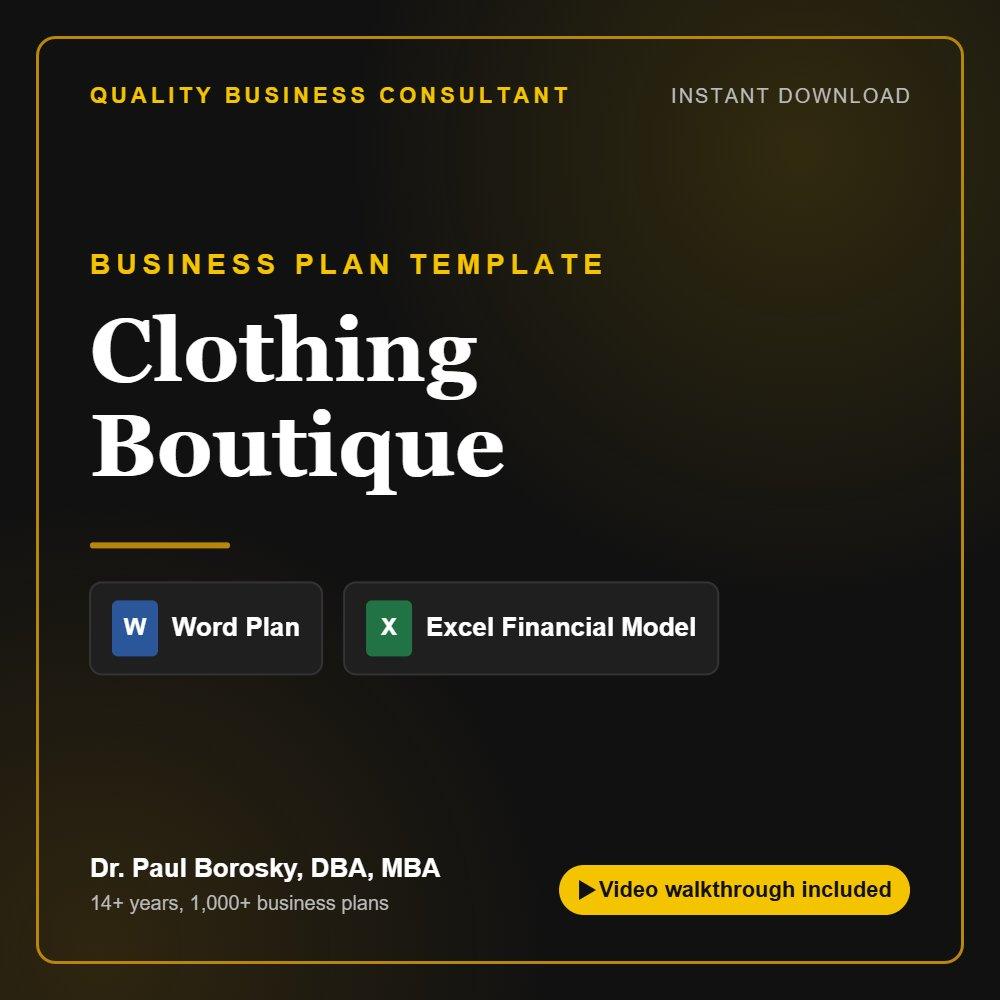
Built for Boutique Owners
Boutiques tie up cash in inventory and rent. Lenders want to see what sells and how fast.
This template shows them. Built by Dr. Paul Borosky, DBA, MBA, from 14+ years and 1,000+ client plans.
What Lenders Ask a Boutique Owner
Expect these questions. The template helps you answer them.
- Inventory: buying, sizes, and seasons.
- Location: rent and foot traffic.
- Margins: cost versus price.
What You Get
- The Word plan. Every section laid out for a clothing boutique: executive summary, company description, market analysis, marketing, operations, management, and the financial plan. Swap in your details.
- The Excel model. Enter your numbers. Revenue, expenses, the profit and loss (P&L) statement, and projections calculate for you.
- The videos. Dr. Paul walks you through how to use the template and how to build your financial projections.
Who It’s For
- First-time boutique owners
- Online sellers opening a store
- Owners going for an SBA loan
How to Use It
- Watch the walkthrough videos first.
- Fill in the Word plan, section by section.
- Enter your numbers in the Excel model.
- Review it before it goes to the lender.
Rather have Dr. Paul write it? See business plan writing at QualityBusinessPlan.com.
Business already running? Dr. Paul helps boutique owners price the work and protect the cash. See Dr. Paul’s consulting services for boutique owners.
Comparing a clothing boutique with other ideas? Carrying higher-priced labels? The designer clothing business plan template plans for bigger inventory dollars. Focused only on women’s lines? Start from the women’s apparel store business plan template. Do accessories outsell the racks? The handbags and accessories store business plan template is built for that mix.
Tips for Expanding Your Clothing Boutique Plan
What decides a clothing boutique plan is Target Market, Popular Products and Services, Pricing Strategy, and Social Media Marketing. Those four have drafts waiting in the template. Use the tips in this section to add the customer, the buying plan, and the markdowns.
See Dr. Paul’s walkthrough videos for how the template is filled in. The Word plan and the Excel model are both shown. This section is about the boutique.
Sections in the template: Company Summary, Target Market, Funding Request, Popular Products and Services, Competitive Advantages, Pricing Strategy, Hours of Operation, Location, Business Objectives and Timeline, Industry Overview, SWOT Analysis, Ownership, Organizational Chart, Marketing, Traditional Marketing, Networking, Internet Marketing, Social Media Marketing, Labor, Startup Costs, Monthly Fixed Costs, and Growth Rates.
1. Target Market
Add one customer.
How to get it. Picture the person who will buy most often. Write her age range, where she works, what she spends on an outfit, and where she shops now. Then interview twenty women who fit.
How to use it. Describe that one customer in Target Market, since a boutique that buys for everyone ends up with racks no one wants.
Add how many of her live nearby.
How to get it. Look up population, age, and household income for your area on Census QuickFacts.
How to use it. Use the figures to show the neighborhood holds enough of your customer to support the sales you forecast.
Add where she shops now.
How to get it. Visit the boutiques, department stores, and chains she uses. Note price points, sizes carried, and what is missing.
How to use it. State the gap you fill in Competitive Advantages, whether that is a price point, a size range, or a style no one near you carries.
Add sizes.
How to get it. Ask your twenty interviewees their sizes. Ask other owners which sizes sell out and which get marked down.
How to use it. State the size range you carry and why, and say how you avoid being left with only the sizes that did not sell.
Add occasions.
How to get it. Ask what she shops for: work, weekends, events, vacations, or gifts.
How to use it. Shape your categories around the top two occasions and give the rest only a small share of the buying budget.
Add tourists or locals.
How to get it. Stand on the street and watch who walks by. Ask neighbors how much of their trade is visitors.
How to use it. Say which you depend on and how the seasons change it, and show that swing in your monthly sales.
Add online shoppers.
How to get it. Ask your interviewees how often they buy clothes from a phone and from whom.
How to use it. Explain what brings her into a store instead, such as trying things on and getting styled.
Add a starting list.
How to get it. Collect emails and phone numbers at pop-ups or markets before you open.
How to use it. Report how many names you have, because a list of future customers is evidence a lender can count.
2. Popular Products and Services
Add your categories.
How to get it. Divide the store into tops, bottoms, dresses, outerwear, accessories, and gifts. Decide the share of the budget each gets.
How to use it. Show the split in a small table and revisit it each season based on what sold.
Add your vendors.
How to get it. Attend a wholesale market or browse the online wholesale marketplaces. Ask each brand for its minimum order, its terms, and whether it sells to stores near you.
How to use it. Name your main brands and their terms, and note which ones let you reorder a style that sells out.
Add your buying calendar.
How to get it. Ask vendors when each season ships. Fall goods are ordered months before fall.
How to use it. Lay out when you order and when you pay for each season, because cash leaves long before the clothes sell.
Add how deep you buy.
How to get it. Ask owners how many of each style and size they order. Small runs sell out and create urgency. Big runs get marked down.
How to use it. State your rule, such as six pieces per style, and why.
Add new arrivals.
How to get it. Ask owners how often they put out new stock and what it does to visits.
How to use it. Describe how often the floor changes and how you tell customers that new pieces have arrived.
Add accessories and gifts.
How to get it. Ask which small items sell at the register.
How to use it. Add them as a category with a higher markup, and place them where a shopper waits to pay.
Add styling and events.
How to get it. Price a private shopping night or a styling appointment.
How to use it. Describe these as services that a website cannot match, and estimate the sales one private evening brings.
Add your own label, later.
How to get it. Ask a manufacturer what a small private-label run requires.
How to use it. Place it in Business Objectives and Timeline as a later step, after you know which styles your customer buys again and again.
3. Pricing Strategy
Add your markup.
How to get it. Ask your vendors for wholesale prices and suggested retail prices. Work out the markup on each category.
How to use it. State the markup you use and show two items as examples.
Add your price range.
How to get it. Check your prices against what your interviewees said they spend.
How to use it. State the range for each category and confirm it sits inside what your interviewees said they pay.
Add markdowns.
How to get it. Ask two owners what share of each season sells at full price and what share is discounted.
How to use it. Lower your forecast margin to match, because no boutique sells everything at full price.
Add your sale calendar.
How to get it. Decide when you mark down and by how much. End of season is the usual time.
How to use it. Describe the schedule so discounts look planned, and say where unsold pieces go after the final markdown.
Add your average sale.
How to get it. Ask owners how many pieces a customer buys per visit and what she spends.
How to use it. Multiply it through. Say 25 sales a day at $85. That is $2,125 a day, and it gives the reader a number to test.
Add returns.
How to get it. Read the return policies of stores like yours.
How to use it. State your policy, store credit or refund, and reduce sales slightly for returns.
Add your open-to-buy.
How to get it. Ask an owner or an accountant how to set a monthly buying budget from planned sales and stock on hand.
How to use it. Show the monthly budget, since overbuying is the most common way a boutique runs out of cash.
Add theft and damage.
How to get it. Ask your insurer and other owners what goes missing.
How to use it. Add a small allowance to cost of goods.
4. Social Media Marketing
Add where she spends her time.
How to get it. Ask your interviewees which apps they use and which stores they follow.
How to use it. Name the one or two platforms you will focus on and leave the rest alone until those are working.
Add what you post.
How to get it. Study three boutiques with strong followings. Note how often they post try-ons, new arrivals, and outfits.
How to use it. Describe your weekly posting plan and who does it.
Add selling from posts.
How to get it. Look at how other boutiques let followers claim an item from a post or a live video.
How to use it. Explain your method and how orders are paid and picked up or shipped.
Add photos.
How to get it. Decide who models and who shoots. Price a simple lighting setup.
How to use it. Put the cost in your budget and note that clothes shown on a real person sell better than clothes on a hanger.
Add local voices.
How to get it. Find local women with engaged followings and ask what a partnership would cost.
How to use it. List the ones you will work with and what each receives.
Add text and email.
How to get it. Compare two services that send new-arrival alerts to your list.
How to use it. Enter the monthly fee and say how often you send, since too many messages cost you subscribers.
Add in-store events.
How to get it. Plan a launch party and one event each season.
How to use it. Put the calendar in Marketing with the cost of each event and the sales you expect from it.
Add what you measure.
How to get it. Decide which numbers you track, such as sales from each post and new names on the list.
How to use it. State that you review them monthly and shift time toward whatever is producing sales.
FAQ
- Does it work for a mobile boutique? Yes. Describe the truck or pop-up model.
- What about online sales? Add them in Excel.
Good to Know
- All sales are final. The files download instantly.
- Paid with PayPal and the download didn’t start? Use a card through Stripe.
- Download or file problem? Email Paulb@Qualitybusinessplan.com and it gets fixed within 24 hours.
- By purchasing, you agree to the Terms and Conditions.